Isolation before explanation.
Control the branch before naming the mechanism.
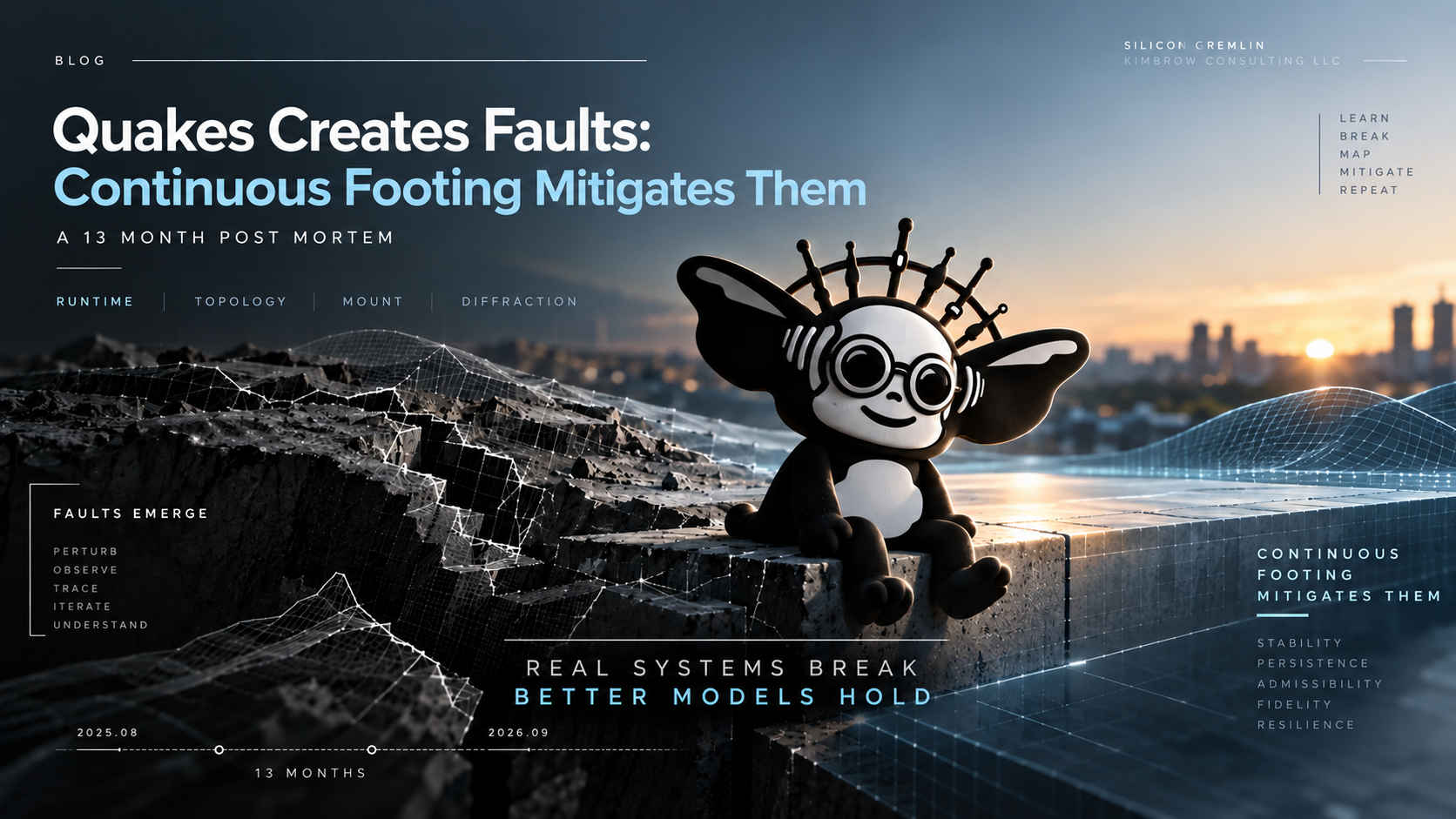
Silicon Gremlin · Kimbrow Consulting LLC · Blog
A 13 month post mortem
Thirteen months ago, the story was about finding a faint signal and proving it survived observation. That story ended at a null *ptr. This one begins with what survived after the system moved.
FROM NEBULA TO NULL PTR / HANDOFF
From Nebula to null *ptr documented the empirical seed: isolate the signal, control the variables, repeat the observation, and refuse to promote surprise into evidence. At the time, DIFFRACTION was the name for what grew out of that method—not yet the full theoretical object it would become.
Split the signal. Weight the channels. Reject outliers. Stack observations. Stretch hidden structure until the pattern becomes visible.
That language began as an explanation of astrophotography. Over the next thirteen months, it became something stranger: the representation itself became part of the experiment.
QUAKES CREATE FAULTS
A perturbation does not need to destroy a system to teach you where its boundaries are. It can expose a mismatch between layers, a state transition that loses observability, a representation that no longer preserves what the next layer assumes, or a recovery path that behaves differently from the path that created the state.
The mistake I made early was treating the visible fault as the interesting object. The better question was what had to remain continuous for the fault not to emerge.
CONTINUOUS FOOTING
That changed the work. Instead of asking whether two observations looked consistent, the research began asking whether a transition was admissible under the representation available to the system at that moment.
The useful footing became a set of constraints: persistence across transitions, representation fidelity, admissibility, and enough observability to distinguish a genuine state change from a change in how the state was projected.
REPRESENTATION BECOMES THE OBJECT
DIFFRACTION led into Causal Layer Integration, latent-versus-observable state work, and eventually experiments where the representation could no longer be treated as a neutral window. Precision, ordering, alignment, normalization, projection, and transform choice could manufacture structure, erase structure, or preserve only part of it.
That forced a harder standard: a compelling visualization is not evidence that the underlying object contains the same geometry. The pattern has to survive an explicitly defined family of admissible representational transformations—or its dependence has to be characterized honestly.
RUNTIME / BOUNDARY
The runtime work made that painfully concrete. A system can carry latent state that is only partially visible through a measurement surface. Increase instrumentation, change the path, alter the observer, or move the boundary and the behavior may disappear, transform, or become a different experiment entirely.
The lesson was not “trust less instrumentation.” It was the opposite: characterize the instrumentation as part of the experimental system.
POST-MORTEM LEDGER
Control the branch before naming the mechanism.
The same primitive can tell different stories through different surfaces.
Transitions, constraints, and preservation became more useful than spectacle.
Attribution and explanation earn precision; they do not receive it up front.
A failed branch can still reduce the hypothesis space.
Logs, traces, controls, timestamps, and frozen artifacts preserve the epistemic state.
AFTER NULL PTR
The point of a post-mortem is not to pretend the path was linear. It is to recover the sequence faithfully enough that the mistakes remain useful. The first artifact taught me to quiet noise without losing light. The next thirteen months taught me that the filter, the observer, the boundary, and the representation all belong inside the model.
So this is not a victory lap. It is a continuity check.
Perturb. Observe. Trace. Iterate. Understand.
Then see what still holds when the ground moves.